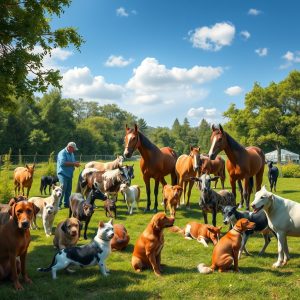
The Whispering Winds: How Tracking Dogs Decipher the Ancient Language of the Wilderness

The wilderness breathes in rhythms older than humanity itself, a symphony of rustling leaves, distant howls, and the faintest whispers of wind carrying secrets across vast landscapes. For centuries, humans have sought to understand this language, to decode the stories etched into the earth by the paws, hooves, and claws of its inhabitants. Yet, no tool has proven as adept at translating these silent narratives as the keen nose of a tracking dog. These remarkable canines, with their extraordinary olfactory abilities, are not merely companions to conservationists and researchers—they are the living bridges between the seen and the unseen, the known and the mysterious.
The Nose That Knows No Bounds
Imagine standing at the edge of a dense forest, the air thick with the scent of damp earth and pine. To the average person, the wilderness appears as a static tableau, a snapshot of nature frozen in time. But to a tracking dog, it is a dynamic, ever-changing storybook, each page filled with the scent trails of creatures that have passed through. Bloodhounds, with their drooping ears and soulful eyes, are often the first breed that comes to mind when one thinks of tracking. Their noses are legendary, capable of detecting a single molecule of scent among billions, a skill that has made them indispensable in search and rescue missions, law enforcement, and, increasingly, wildlife conservation.
Yet, the world of tracking dogs extends far beyond the bloodhound. Breeds like the Belgian Malinois, German Shepherd, and even the unassuming Beagle have been trained to follow scent trails with astonishing precision. These dogs are not just tracking animals; they are reading the very essence of the wild, interpreting the language of scent in ways that humans can only begin to comprehend. Their work has led to groundbreaking discoveries in animal behavior, migration patterns, and even the impacts of climate change on wildlife habitats.
Guardians of the Fragile Web
In the delicate balance of ecosystems, apex predators like wolves, lions, and tigers play a crucial role. Their presence—or absence—can ripple through an environment, altering the behavior of prey species and even the landscape itself. Tracking dogs have become vital allies in studying these elusive creatures, offering researchers a way to monitor their movements without intrusive methods that might disrupt their natural behaviors. By following the scent trails of these predators, dogs can help scientists map their territories, understand their hunting patterns, and identify potential threats to their survival.
One of the most compelling examples of this work is found in the savannas of Africa, where tracking dogs have been deployed to study the movements of lions and cheetahs. These big cats, often shrouded in mystery, leave behind scent markers that dogs can follow for miles. The data gathered from these expeditions has provided invaluable insights into the social structures of these animals, their interactions with other species, and the challenges they face in an ever-shrinking habitat. In turn, this knowledge has informed conservation strategies, helping to protect these majestic creatures from the myriad threats they encounter.
The Technology Behind the Nose
While the natural abilities of tracking dogs are awe-inspiring, modern technology has amplified their impact. GPS collars, drones, and advanced data analytics have transformed the way researchers use these dogs in the field. A tracking dog equipped with a GPS collar can cover vast distances, its movements recorded in real-time and analyzed to reveal patterns that would be impossible to detect with the naked eye. Drones, meanwhile, can provide aerial views of the terrain, helping handlers guide their dogs more effectively and avoid potential hazards.
Perhaps most exciting is the development of artificial intelligence tools that can process the vast amounts of data collected by tracking dogs. Machine learning algorithms can identify patterns in animal behavior, predict migration routes, and even detect early signs of disease or stress in wildlife populations. This fusion of canine instinct and cutting-edge technology is opening new frontiers in wildlife research, offering hope for some of the planet’s most vulnerable species.
The Bond That Transcends Species
At the heart of every tracking dog’s success is the bond they share with their human handlers. This relationship is built on trust, communication, and a deep mutual respect. Handlers must learn to read their dogs’ body language, interpreting subtle cues that indicate a scent has been detected or a trail has gone cold. In return, the dogs rely on their handlers to provide guidance, protection, and, of course, the occasional treat as a reward for a job well done.
This partnership is particularly evident in search and rescue operations, where tracking dogs have saved countless lives. Whether it’s locating a missing hiker in the mountains or a child lost in the woods, these dogs work tirelessly, their noses to the ground, driven by an innate desire to find what is lost. The emotional connection between handler and dog in these moments is palpable, a testament to the power of interspecies collaboration.
Preserving the Wild for Future Generations
The work of tracking dogs extends beyond the immediate goals of research and conservation. It is, at its core, a mission to preserve the wild for future generations. Every scent trail followed, every animal tracked, and every piece of data collected is a step toward understanding and protecting the intricate web of life that sustains our planet. These dogs are not just tools; they are ambassadors of the wild, their efforts ensuring that the stories of the wilderness continue to be told.
As the sun sets over a vast, untamed landscape, the wind carries with it the faintest traces of the day’s journeys—of a deer that passed through at dawn, a fox that hunted under the cover of dusk, and a bear that left its mark on the bark of an ancient tree. To most, these scents are invisible, lost to the passage of time. But to a tracking dog, they are the threads of a tapestry that tells the story of the wild. And as long as there are noses to follow these threads and hearts to care for the creatures that leave them behind, the wilderness will never truly be silent.