The Scented Path: How Tracking Dogs Are Preserving the Wild’s Most Elusive Stories
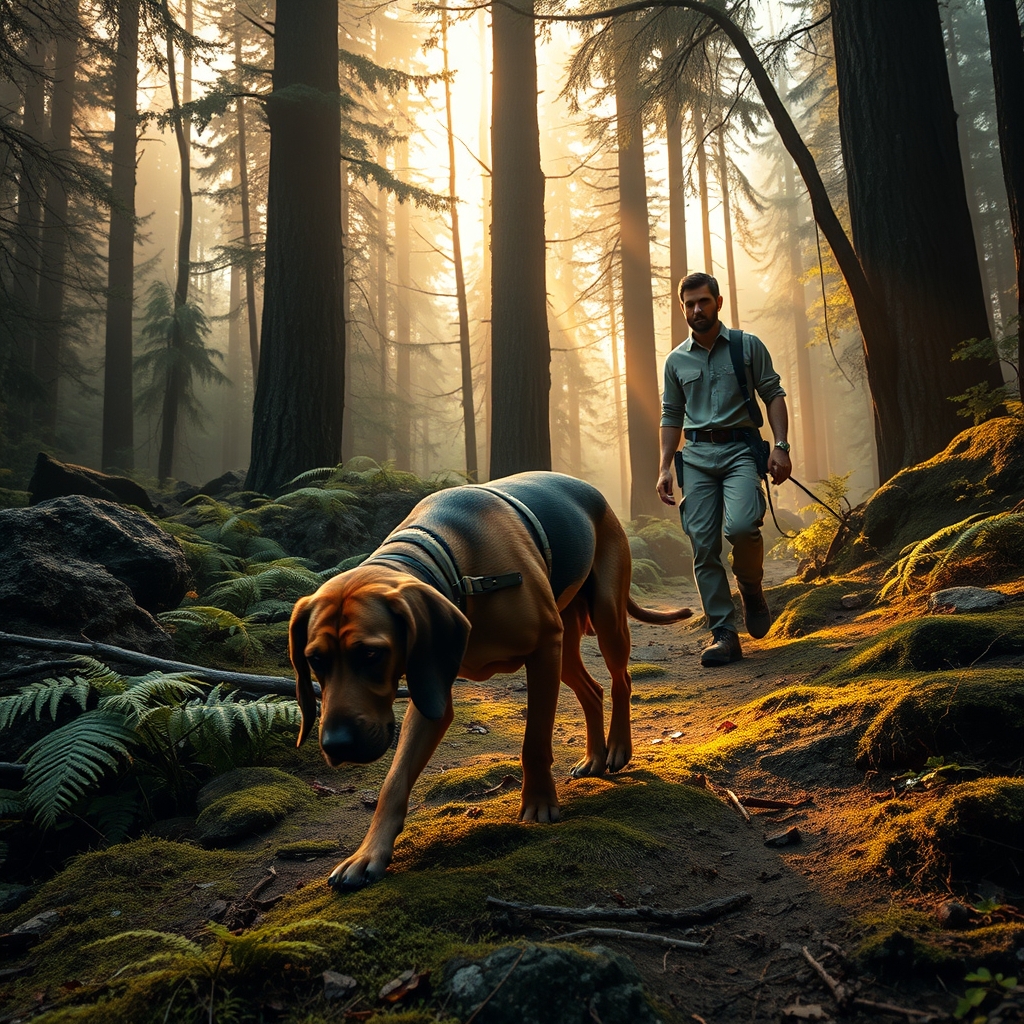
The morning mist clings to the forest floor like a ghostly veil, swirling around the gnarled roots of ancient trees. Somewhere in the distance, a twig snaps—a sound so faint it might have been imagined. But the Bloodhound standing at the edge of the clearing doesn’t hesitate. Her ears, velvety and long, twitch as she lifts her head, nostrils flaring to capture the invisible threads of scent carried on the breeze. This is the moment where instinct and science collide, where the primal art of tracking meets the modern urgency of wildlife conservation. For centuries, humans have relied on the extraordinary olfactory abilities of dogs to navigate the wild, but today, these four-legged detectives are doing far more than leading hunters to their quarry. They are uncovering the hidden narratives of the natural world, one scent at a time.
The Nose That Knows No Bounds
Tracking dogs, particularly breeds like the Bloodhound, Beagle, and German Shorthaired Pointer, possess olfactory systems that border on the supernatural. A dog’s nose contains up to 300 million scent receptors—compared to a human’s paltry 6 million—and a portion of their brain dedicated to processing smells that is 40 times larger than ours. This biological marvel allows them to detect odors at concentrations as low as one part per trillion. To put that into perspective, if a single drop of blood were diluted in 20 Olympic-sized swimming pools, a Bloodhound could still pick up its scent. It’s this almost otherworldly ability that makes them indispensable in the field of wildlife conservation.
But what exactly are these dogs tracking? The answer is as varied as the wild itself. In the dense rainforests of Central Africa, tracking dogs have been deployed to locate elusive gorillas and forest elephants, species that are notoriously difficult to study due to their remote habitats and elusive nature. In the vast plains of the Serengeti, they’ve been used to monitor the movements of cheetahs and lions, providing researchers with data that was once nearly impossible to obtain. Closer to home, in the rugged mountains of North America, they’ve helped biologists track the reclusive wolverine, a species so secretive it’s often called the “ghost of the wilderness.”
From Hunters to Protectors: A Shift in Purpose
The relationship between humans and hunting dogs dates back thousands of years, with evidence of their partnership appearing in ancient Egyptian hieroglyphs and Roman mosaics. For millennia, these dogs were bred and trained for a singular purpose: to aid in the pursuit of game. But as the world has changed, so too has their role. The rise of wildlife conservation in the 20th century brought with it a new mission for these canine companions. No longer were they merely tools for the hunt; they became allies in the fight to protect the very creatures they were once trained to pursue.
One of the most groundbreaking applications of tracking dogs in conservation is their use in combating poaching. In Africa, where rhinos and elephants are relentlessly targeted for their horns and tusks, anti-poaching units have turned to dogs to patrol national parks and reserves. These dogs, often Belgian Malinois or Dutch Shepherds, are trained to detect the scent of gunpowder, ivory, and even the sweat of poachers hiding in the bush. Their presence alone has been shown to deter illegal activity, and their tracking skills have led to the arrest of countless poachers. In some regions, the introduction of K9 units has resulted in a dramatic decline in poaching incidents, offering a glimmer of hope for species on the brink of extinction.
The Science Behind the Sniff
While the natural abilities of tracking dogs are awe-inspiring, their effectiveness in conservation is not left to chance. Behind every successful tracking dog is a team of dedicated trainers and scientists who have honed their skills through rigorous, methodical training. The process begins with imprinting, where dogs are exposed to the specific scents they will be tracking—whether it’s the musk of a pangolin, the pheromones of a rare salamander, or the residual odor of a poacher’s boot. This is followed by scent discrimination training, where dogs learn to distinguish their target scent from a myriad of others in the environment.
Technology has also played a pivotal role in enhancing the capabilities of tracking dogs. GPS collars allow researchers to monitor the movements of both the dogs and the animals they track, providing real-time data that can be used to map migration patterns, identify critical habitats, and even predict human-wildlife conflicts. Drones equipped with thermal imaging cameras work in tandem with tracking dogs, offering a bird’s-eye view of the landscape and helping to locate animals that might otherwise remain hidden. Together, these tools create a powerful synergy, amplifying the dogs’ natural abilities and extending their reach far beyond what was once possible.
The Unseen Heroes of the Wild
Perhaps the most remarkable aspect of tracking dogs in conservation is their ability to uncover the stories of the wild that would otherwise go untold. Every paw print they follow, every scent they decipher, is a piece of a larger puzzle—a puzzle that reveals the intricate web of life that sustains our planet. In the hands of skilled handlers, these dogs become more than just tools; they become storytellers, narrating the lives of creatures great and small through the language of scent.
Consider the case of the Florida panther, a subspecies of cougar that was once on the verge of extinction. In the 1990s, fewer than 30 individuals remained, their numbers decimated by habitat loss and vehicle collisions. Conservationists turned to tracking dogs to locate the remaining panthers, map their territories, and identify critical corridors for their survival. The data collected by these dogs was instrumental in the implementation of wildlife crossings and habitat restoration projects, which have since allowed the Florida panther population to rebound. Today, there are over 200 panthers roaming the wilds of Florida, a testament to the power of tracking dogs in rewriting the fate of an endangered species.
The Bond That Makes It Possible
At the heart of every successful tracking dog is a bond—a silent understanding between dog and handler that transcends words. This relationship is built on trust, mutual respect, and an unspoken language of gestures, glances, and subtle shifts in body language. A handler must learn to read their dog’s cues, interpreting the slightest change in posture or the intensity of a sniff to determine whether they’re on the right track. In return, the dog must trust that their handler will guide them safely through the wilderness, providing the support and encouragement they need to do their job.
This bond is particularly evident in the world of search and rescue, where tracking dogs have saved countless lives. Whether it’s locating a lost hiker in the mountains or a child who has wandered into the woods, these dogs approach their work with a level of dedication that is nothing short of heroic. Their success is a reminder that the partnership between humans and dogs is one of the oldest and most enduring in history, a partnership that continues to evolve and adapt to the challenges of the modern world.
The wild is a place of endless mystery, where the stories of its inhabitants are written in the rustle of leaves, the imprint of a paw, and the faintest whisper of scent on the wind. Tracking dogs, with their extraordinary noses and unwavering determination, are the key to unlocking these stories. They bridge the gap between the seen and the unseen, the known and the unknown, offering us a glimpse into the lives of creatures that would otherwise remain hidden. In doing so, they remind us that conservation is not just about protecting individual species or habitats; it’s about preserving the intricate, interconnected tapestry of life that sustains us all. And as long as there are wild places left to explore, there will be tracking dogs leading the way, their noses to the ground, their hearts set on the trail ahead.