The Unseen Trackers: How Scent Hounds Are Redrawing the Map of Wildlife Habitats
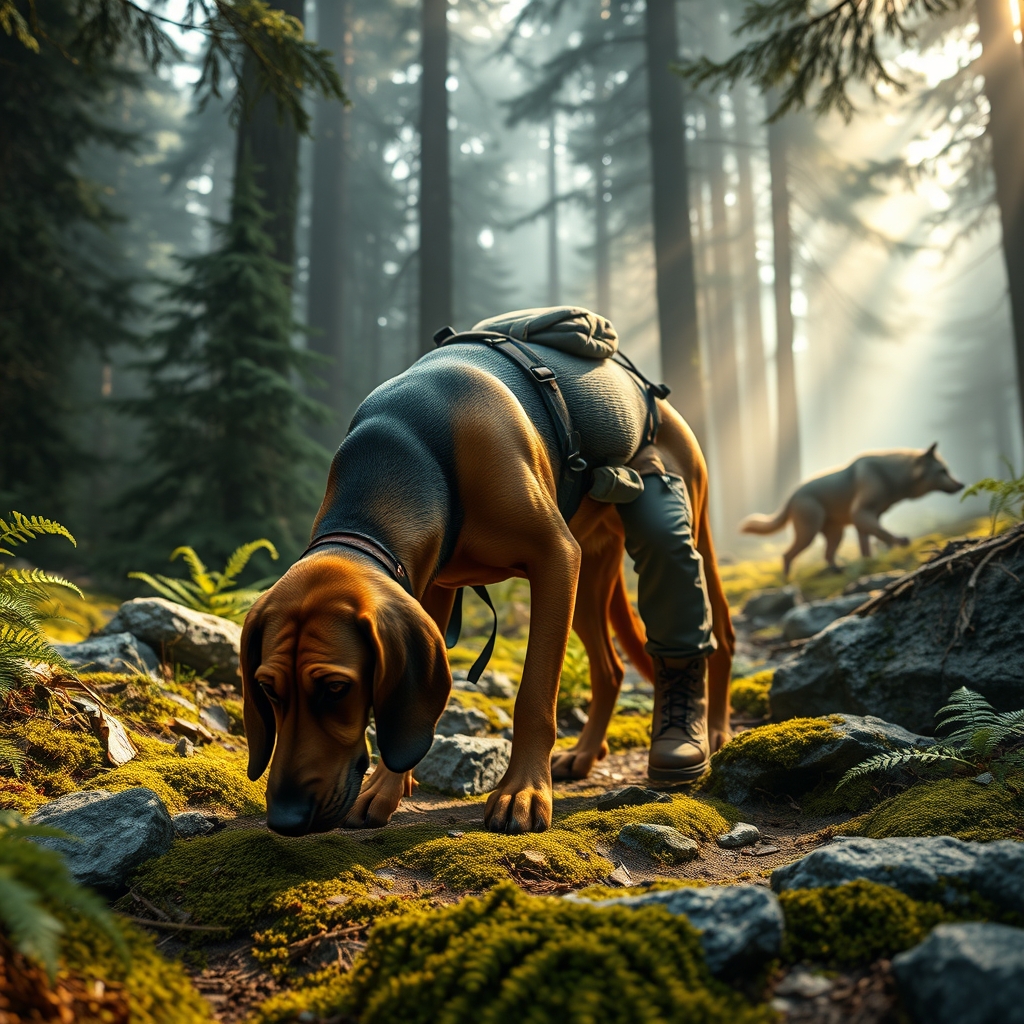
The morning mist clings to the forest floor like a ghostly veil, swirling around the sturdy legs of a Bloodhound as it lowers its massive head to the earth. The air is thick with the scent of damp soil, pine needles, and something else—something wild and elusive. The dog’s nostrils flare, inhaling the invisible threads of a story only it can read. With a low, rumbling bay, it begins to move, its paws pressing into the soft earth as if pulled by an unseen force. This is not a hunt for prey, nor a search for a lost hiker. This is something far more profound: a journey into the heart of a wilderness that is vanishing before our eyes.
The Nose That Knows No Bounds
Tracking dogs, particularly breeds like the Bloodhound, the German Shorthaired Pointer, and the Belgian Malinois, possess olfactory abilities that border on the supernatural. A human’s nose might detect the faintest hint of coffee brewing in the next room, but a scent hound’s nose can distinguish between the individual scents of a hundred different animals in a single breath. Their nasal cavities are lined with up to 300 million scent receptors—compared to a human’s paltry 6 million—allowing them to detect odors at concentrations as low as one part per trillion. To put that into perspective, if a scent were a single drop of water, a Bloodhound could detect it in a body of water the size of 20 Olympic swimming pools.
This extraordinary sense of smell is not just a biological marvel; it is a tool that is reshaping our understanding of wildlife habitats. Conservationists and researchers have long relied on camera traps, GPS collars, and field observations to study animal movements, but these methods have limitations. Camera traps can only capture what passes in front of them, GPS collars require capturing and tagging animals, and field observations are often constrained by human presence. Scent hounds, however, offer a non-invasive, dynamic way to track animals across vast and varied landscapes. They can follow the trail of a single individual for miles, even days after the animal has passed, providing insights into migration routes, territorial boundaries, and even social structures within animal populations.
The Invisible Cartographers
Imagine a map of a national park, its contours and trails etched in ink, but with vast blank spaces where the movements of its wild inhabitants should be. For decades, these blank spaces have represented the unknown—the secret lives of animals that slip through the shadows, unseen and unrecorded. Scent hounds are changing that. By tracking the movements of apex predators like wolves, bears, and big cats, these dogs are helping researchers fill in the gaps, revealing the hidden pathways that crisscross the wilderness.
In the dense forests of the Pacific Northwest, for example, tracking dogs have been instrumental in studying the elusive gray wolf. Wolves are notoriously difficult to track; they cover vast distances, avoid human contact, and their territories often overlap with those of other predators. Traditional tracking methods, such as radio collars, require capturing the animals, which is stressful for the wolves and logistically challenging for researchers. Scent hounds, however, can follow a wolf’s trail for days, even weeks, without ever disturbing the animal. They can detect where a wolf has marked its territory, where it has hunted, and even where it has interacted with other wolves. This information is invaluable for conservationists working to protect wolf populations and mitigate human-wildlife conflicts.
The Technology Behind the Trail
While the natural abilities of scent hounds are awe-inspiring, modern technology is amplifying their impact. GPS collars fitted on the dogs themselves allow researchers to map their movements in real-time, creating a digital record of the trails they follow. Drones equipped with thermal imaging cameras can then be deployed to locate the animals the dogs are tracking, providing visual confirmation of their presence. This combination of old-world tracking and cutting-edge technology is opening new frontiers in wildlife research.
In Africa, where poaching threatens some of the continent’s most iconic species, scent hounds are being used to track down poachers before they can strike. Anti-poaching units train dogs to detect the scent of gunpowder, ivory, and even the sweat of humans hiding in the bush. These dogs can cover ground far more quickly than human trackers, and their keen noses can pick up a scent trail that would be invisible to the human eye. The result is a more effective, more efficient way to protect endangered species like elephants and rhinos, whose populations have been decimated by illegal hunting.
The Bond That Bridges Worlds
The relationship between a tracking dog and its handler is one of the most extraordinary partnerships in the animal kingdom. It is built on trust, communication, and an almost telepathic understanding of one another’s movements and intentions. A handler must learn to read the subtle cues of their dog—the tilt of the head, the flick of an ear, the change in breathing—that signal the presence of a scent. The dog, in turn, must trust its handler to guide it, to interpret its signals, and to keep it safe in often dangerous environments. This bond is not forged overnight; it takes months, even years, of training and shared experiences to develop.
For the dogs, the work is not just a job; it is a calling. Many scent hounds are bred for their tracking abilities, and their instincts drive them to follow a trail to its end. They thrive on the mental and physical challenge of tracking, and the reward of a successful find—whether it’s locating a lost child, uncovering a poacher’s hideout, or mapping the movements of a rare species—is written in the wag of their tail and the spark in their eyes. For the handlers, the work is equally rewarding. There is a profound sense of purpose in knowing that their partnership with their dog is making a tangible difference in the world, whether it’s protecting an endangered species, preserving a fragile habitat, or simply uncovering the secrets of the wild.
The Future of the Trail
As the world’s wild places continue to shrink under the pressures of human development, climate change, and exploitation, the role of tracking dogs in wildlife conservation is more critical than ever. These dogs are not just tools; they are ambassadors between the human world and the natural one, bridging the gap with their extraordinary senses and unwavering dedication. They remind us that the wilderness is not just a place to be observed from a distance, but a living, breathing entity that we are a part of—and that we have a responsibility to protect.
The next time you see a Bloodhound or a German Shorthaired Pointer, take a moment to appreciate the unseen world they inhabit. Behind those soulful eyes and floppy ears lies a universe of scents, a map of the wild that is as intricate as it is invisible. These dogs are not just tracking animals; they are tracking the very essence of the natural world, one scent at a time. And in doing so, they are helping us to see the wilderness not as a distant, untouchable realm, but as a vital, interconnected web of life that we are all a part of. Their work is a testament to the power of partnership, the resilience of nature, and the enduring bond between humans and animals—a bond that may just hold the key to preserving the wild for generations to come.