The Silent Guardians: How Scent Hounds Protect Endangered Species in the Wild
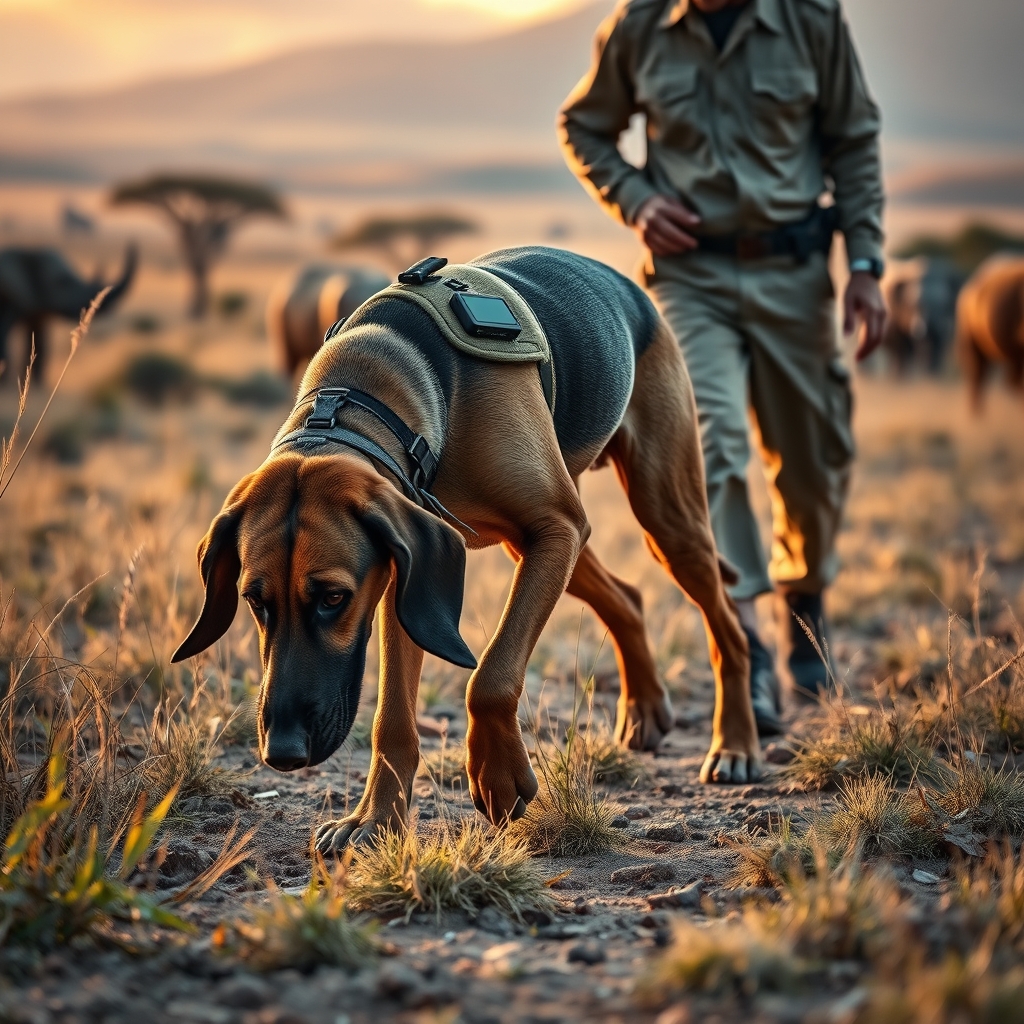
The dense undergrowth of the African savanna rustles as a shadow moves with purpose. Ears flop with each determined step, nose pressed close to the earth, inhaling the ancient language of scent. This is no ordinary dog—it is a Bloodhound, a living compass of the wild, trained not to hunt for sport, but to safeguard the most vulnerable creatures on Earth. In the quiet battle to preserve endangered species, these scent hounds have become the silent guardians of the wilderness, their extraordinary abilities rewriting the rules of wildlife conservation.
The Nose That Knows No Borders
For centuries, Bloodhounds and other scent hound breeds have been celebrated for their unparalleled olfactory prowess. With over 300 million scent receptors—compared to a human’s mere 6 million—these dogs perceive the world in a symphony of smells we can scarcely imagine. While humans might catch a faint whiff of decay or blossom, a trained tracking dog discerns individual notes: the musk of a leopard’s paw, the earthy trail of a pangolin’s passage, or the subtle chemical signature of a poacher’s boot.
This sensory superpower is not just a biological marvel; it is a conservation tool of unmatched precision. In regions where endangered species like rhinos, elephants, and tigers roam, anti-poaching units are increasingly turning to scent hounds to detect illegal activity. Unlike drones or cameras, which can be evaded or disabled, a Bloodhound’s nose is relentless. It follows trails days old, crosses rivers, and navigates dense forests where human trackers would falter. In South Africa’s Kruger National Park, for instance, K9 units have intercepted poachers with a success rate that has left criminals stunned—and conservationists hopeful.
From Hunting to Healing: A New Role for Ancient Breeds
The history of scent hounds is deeply entwined with hunting. Breeds like the Bloodhound, Beagle, and Coonhound were developed to pursue game, their instincts honed over generations. But as the world’s relationship with wildlife evolves, so too does the role of these dogs. Today, they are being repurposed not to take life, but to preserve it. Training a scent hound for conservation work is a delicate balance of instinct and discipline. Handlers must channel the dog’s natural drive to track while ensuring they remain non-aggressive toward wildlife. The goal is not to chase, but to detect.
In the field, these dogs are often deployed in two key ways: tracking and detection. Tracking dogs follow the scent of poachers or missing animals, leading rangers to hidden traps, snares, or illegal camps. Detection dogs, on the other hand, are trained to sniff out specific contraband—ivory, rhino horn, or pangolin scales—at checkpoints, ports, and border crossings. Their accuracy is staggering; studies have shown that well-trained scent hounds can detect contraband with a success rate exceeding 90%, far outpacing traditional methods like X-ray scans or manual searches.
The Bond That Saves Lives
Behind every successful scent hound is a handler who understands the language of trust. The relationship between a tracking dog and its handler is built on mutual respect, patience, and an almost telepathic connection. Handlers learn to read their dog’s body language—the subtle shift in posture, the flick of an ear, the intensity of a tail wag—each a clue to what the dog has discovered. In return, the dogs learn to communicate their findings, whether through a sit, a bark, or a focused stare at a hidden cache of ivory.
This bond is particularly critical in high-stakes environments where danger lurks around every corner. In the dense jungles of Sumatra, where critically endangered Sumatran tigers roam, rangers and their scent hounds work in tandem to dismantle poaching networks. The dogs’ presence alone can act as a deterrent; poachers know that if a Bloodhound is on their trail, escape is nearly impossible. For the rangers, the dogs are more than tools—they are partners, protectors, and sometimes, lifesavers.
Beyond the Nose: Technology Meets Tradition
While scent hounds are unmatched in their tracking abilities, modern conservation efforts are increasingly integrating technology to amplify their impact. GPS collars allow handlers to monitor their dogs’ movements in real-time, ensuring their safety in vast and often treacherous landscapes. Drones equipped with thermal imaging can scout ahead, identifying potential threats or areas of interest for the dogs to investigate. Meanwhile, DNA analysis of scat collected by tracking dogs provides researchers with invaluable data on animal populations, health, and genetic diversity.
Yet, for all the advancements in animal tracking technology, the role of the scent hound remains irreplaceable. Machines cannot replicate the nuanced understanding of scent, nor the adaptability of a dog in the field. In the rugged terrain of the Himalayas, where snow leopards leave barely a trace, or the arid expanses of the Namib Desert, where the wind scatters scent like dust, it is the dog’s nose—and the handler’s trust in it—that makes the difference between success and failure.
The Ripple Effect of a Single Trail
The work of scent hounds in wildlife conservation extends far beyond the immediate capture of poachers or the recovery of contraband. Each successful mission sends a ripple through the ecosystem, deterring future crimes and giving endangered species a fighting chance. In Kenya’s Maasai Mara, the reintroduction of tracking dogs has led to a noticeable decline in poaching incidents, allowing populations of lions and cheetahs to stabilize. In the rainforests of Central Africa, dogs trained to detect illegal logging have helped protect the habitats of gorillas and forest elephants, ensuring these majestic creatures have a future.
Moreover, the presence of scent hounds in conservation efforts has sparked a broader cultural shift. Communities that once viewed wildlife as a threat or a resource to exploit are now seeing these animals—and the dogs that protect them—in a new light. Educational programs that involve local schools and villages in training and caring for the dogs foster a sense of ownership and pride. Children who once dreamed of becoming poachers now aspire to be rangers, inspired by the four-legged heroes that patrol their lands.
The sun dips below the horizon, casting long shadows across the savanna. A Bloodhound named Kibo lifts his head, ears twitching as the evening breeze carries the scent of the wild. His handler watches, a quiet pride in his eyes, knowing that tonight, another poacher will think twice before setting foot in this protected land. The battle to save endangered species is far from over, but with every trail followed, every scent deciphered, and every life saved, the silent guardians of the wild are proving that hope has a nose—and it is unerringly accurate.